
Website: trydax.com/pricing/
Overview
Ambient AI medical scribe that turns clinician-patient conversations into structured notes.
Details
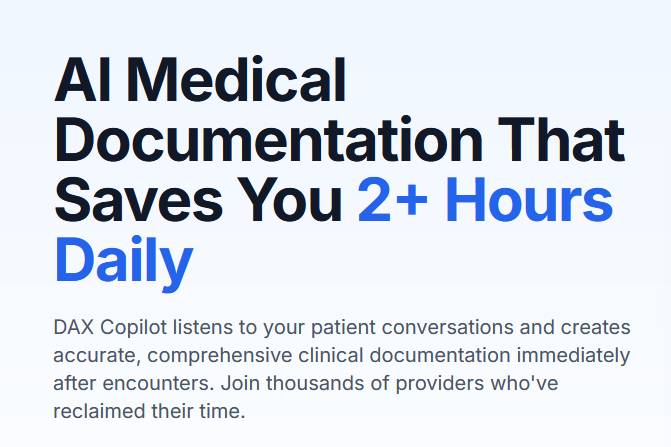
Nuance DAX Copilot (Dragon Ambient eXperience) targets one of the most persistent problems in modern healthcare: documentation overload. Clinicians spend a large portion of their day typing, clicking, and formatting notes—often after clinic hours—because records must be complete, accurate, and consistent. DAX Copilot approaches this with “ambient clinical intelligence.” In approved workflows, it listens to the clinician‑patient conversation and generates a structured clinical note that the clinician can review and finalize.
Patients often feel the benefit immediately: fewer moments where a clinician is staring at a screen, more eye contact, and a more natural conversation. When documentation is less of a burden, clinicians can ask better questions, explain decisions more clearly, and focus more on clinical judgment. At a systems level, better documentation can improve continuity of care because other providers can understand what was discussed, what decisions were made, and what follow-up is required. It can also reduce missed details that sometimes happen when clinicians are rushing to type while the conversation moves on.
DAX Copilot is generally adopted by clinics, hospitals, or provider groups, not by individual consumers. Implementation typically includes workflow setup, permissions, and integration with clinical systems so that notes land where they need to go. Pricing is usually per-provider subscription, and the commercial details depend on buyer type and deployment context.
This is not a diagnostic tool and should not be framed as one. Its purpose is productivity and documentation quality, not replacing clinical judgment. Like other medical scribe products, the final responsibility remains with the clinician to verify accuracy and ensure that the note reflects the visit correctly.
For a healthcare AI tools list, DAX Copilot is a representative example of “behind-the-scenes AI” that improves the patient experience by giving clinicians more time and attention. It’s a reminder that many high-impact healthcare AI products are not consumer apps at all—they work inside clinics to make care delivery feel more human by removing administrative friction.