
If you run an AI tools directory, you’ve likely noticed the same pattern your visitors are living through: “AI agent” is suddenly attached to everything—chatbots, workflow automation, developer tools, even legacy RPA. But not all “agents” are built the same, and that’s exactly why buyers are overwhelmed.
There’s also a second reality that doesn’t get enough attention: much agentic AI is still stuck in pilots. Security, compliance, and “how do we actually run this in production?” are the blockers—not imagination.
This guide is designed to help readers choose an AI agent platform based on the work they need done (not hype). I’ll keep it vendor-neutral, practical, and oriented toward what an AI tools directory audience actually needs: best use cases, strengths, trade-offs, and when each platform is the wrong choice.
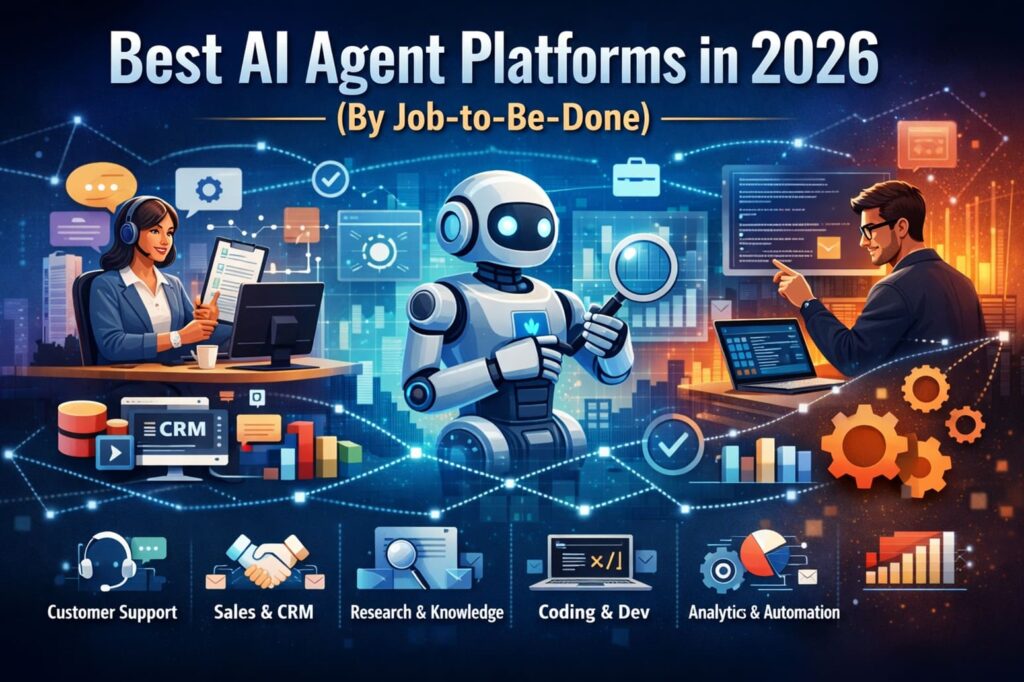
What counts as an “AI agent platform” in 2026?
In 2026, an agent platform is less about “a chatbot that can talk” and more about a system that can plan, call tools, take actions, and leave an auditable trail—often with human approvals in the loop.
Most production-grade platforms converge on the same core capabilities:
- Tool use/actions: the agent can call APIs, run workflows, or trigger automations (and do it reliably).
- Orchestration: multi-step plans, retries, guardrails, and sometimes multi-agent collaboration.
- Grounding: the agent can use your data and content (docs, knowledge base, CRM, etc.).
- Governance + visibility: logs, traces, permissions, and “what happened and why?”
- Structured outputs: schema-validated tool calls and predictable responses for downstream systems.
The selection method that works: pick by job-to-be-done
Instead of “Top agent tools,” start with five questions:
- Where does the work happen? (Microsoft 365, Salesforce, AWS stack, Google Cloud, internal apps, etc.)
- Who builds it? (non-technical ops user, analyst, developer, platform team)
- What actions must it take? (create tickets, update CRM, run payments, deploy code, etc.)
- What data must it touch? (private docs, customer PII, regulated records)
- How much control do you need? (human approvals, restricted tools, audit trails, policy enforcement)
This is why “best platform” is usually the wrong question. The right question is: which platform is best for THIS workflow, in THIS environment, with THIS risk tolerance?
The best AI agent platforms in 2026 (organized by what you’re trying to accomplish)
1) Customer support and service workflows
Microsoft Copilot Studio (best for Microsoft-first organizations)
If your users live in Microsoft 365 and Teams, Copilot Studio is built for this reality: you create agents that connect to organizational tools, data, and channels, and you publish them where work already happens.
Best for
- Internal service desks, HR help, policy Q&A with actions
- Teams-first support experiences
- Organizations standardizing on the Microsoft ecosystem connectors
Strengths
- Strong Microsoft integration and deployment surface area
- Clear path from simple agents to more complex scenarios (Agent Builder → Copilot Studio).
Trade-offs
- Less attractive if your workflow is mostly outside Microsoft apps
Salesforce Agentforce (best for Salesforce-centric support + sales)
Agentforce positions itself as an autonomous agent layer tightly integrated with Salesforce data, reasoning, and actions across workflows and APIs.
Best for
- Customer service and sales workflows where Salesforce is the system of record
- Agents that must act on CRM records and automations without duct-taping integrations
Strengths
- Tight coupling to Salesforce workflows and data model
- “Actions” are natural when the core work already lives in Salesforce.
Trade-offs
- If Salesforce isn’t central, you may be paying for ecosystem gravity you don’t need
ServiceNow + OpenAI (best for enterprise IT ops/service management)
Recent enterprise moves show how quickly agents are becoming embedded into core business software—ServiceNow’s partnership focus is explicitly “AI agents in enterprise workflows.”
Best for
- IT operations, service management, complex ticketing environments
- Enterprises that need agents to navigate “legacy system reality.”
Strengths
- Strong fit for enterprise service workflows and IT task automation (by design intent).
Trade-offs
- Typically, a heavier implementation than lightweight SMB automation
2) Research, knowledge work, and “enterprise Q&A that can act.”
Google Vertex AI Agent Builder (best for Google Cloud enterprises that need governance + scale)
Vertex AI Agent Builder is positioned as a full-stack platform for building, scaling, and governing enterprise-grade agents grounded in enterprise data.
Best for
- Enterprise search + conversational interfaces over internal data
- Google Cloud stack organizations that want governance baked in
Strengths
- “Platform” approach: build, scale, and govern across the lifecycle.
Trade-offs
- If you’re not on Google Cloud, adoption can introduce unnecessary platform complexity
OpenAI Agents SDK + Responses API (best for developers building custom agents)
If you want to ship a custom agent inside your product (or internal apps), OpenAI’s Agents SDK provides core agent primitives: tools, handoffs, streaming, and traceability.
Best for
- Product teams building agentic features into software
- Teams that want an SDK instead of a no-code UI
- Multi-agent workflows with explicit control and tracing
Strengths
- Production orientation and tracing focus
- Clear story around structured outputs and tool calling for reliability.
Trade-offs
- Requires engineering time; not a “click and publish” option
3) Coding and developer productivity agents
This is where 2026 feels different: coding agents are no longer a novelty. Organizations are actively evaluating multiple coding assistants and agentic coding tools in parallel.
Anthropic tool use (best for teams building robust tool-based agents)
Anthropic has been investing heavily in reliable tool use—examples include more advanced orchestration patterns and guidance on writing tools for agents.
Best for
- Developer teams building agents that must use tools safely and consistently
- Structured tool calling with schema validation (“strict” patterns).
Trade-offs
- You still need to build the surrounding orchestration and product workflow
OpenAI agent stack for developer workflows (best for custom coding agents)
OpenAI’s developer direction has been moving toward agent-building primitives and a unified Responses API, with public indications that Responses will eventually replace Assistants.
Best for
- Teams building coding copilots, code review agents, or internal dev tooling
- Structured tool calling, traceability, and multi-step action pipelines
Trade-offs
- You own the “agent product”: permissions, UX, QA, and operational controls
4) Analytics + operations automation (when agents must touch real business processes)
Amazon Bedrock Agents (best for AWS-first enterprises)
Bedrock Agents are built to automate multi-step tasks by connecting models to company APIs and systems, with support for multi-agent collaboration.
Best for
- AWS-native enterprise environments
- Agents that must integrate with internal services and AWS infrastructure
Strengths
- Clear positioning around connecting to systems and orchestrating workflows.
Trade-offs
- Typically not the simplest route for small teams seeking quick wins
UiPath Agentic Automation (best for process-heavy orgs that already do automation)
UiPath is explicitly framing “agentic automation” as orchestration across agents, robots, tools, models, and people—useful in organizations where processes are complex and already automated.
Best for
- Finance ops, invoice disputes, and process automation at scale
- Enterprises that already use RPA and want to add agentic layers
Trade-offs
- Heavier platform footprint than “simple automation” tools
5) SMB and lightweight “get value this week” automation
Zapier Agents (best for non-technical teams that need broad app connectivity)
Zapier positions its agents as AI teammates that can act across a very large app ecosystem, which is exactly what SMBs care about: connectors first, sophistication second.
Best for
- Marketing ops, simple sales ops, back-office workflows
- Teams that want quick automation without engineering
Trade-offs
- Deep customization and strict governance can be harder than developer-first stacks
n8n (best for technical teams who want control + self-hosting options)
n8n emphasizes building multi-step, agent-based systems in a workflow canvas, including multi-agent and tool-calling patterns, and is known for its flexibility in technical environments.
Best for
- Technical ops teams that want “automation + AI agents” with control
- Self-hosting and deeper customization
Trade-offs
- Less “plug and play” than purely no-code tools for non-technical users
A quick decision matrix
If your situation looks like this… | Start here |
Microsoft 365 / Teams is where work happens | Microsoft Copilot Studio (Microsoft Adoption) |
Salesforce is your operating system | Salesforce Agentforce (Salesforce) |
AWS-first enterprise integration | Amazon Bedrock Agents (Amazon Web Services, Inc.) |
Google Cloud enterprise + governed agents | Vertex AI Agent Builder (Google Cloud) |
You’re building custom product agents (dev team) | OpenAI Agents SDK + Responses API (OpenAI Platform) |
You need fast SMB automation across apps | Zapier Agents (Zapier) |
You want workflow flexibility + technical control | n8n (n8n) |
You’re process-heavy and already doing automation | UiPath Agentic Automation (UiPath) |