
Website: math-gpt.org/
Overview
MathGPT is a practical ai math solver that focuses on getting a clean result fast—without a complicated setup. It’s built for people who want a straightforward workflow and predictable output.
Details
MathGPT is positioned as a homework helper that focuses on the part students actually need: the working. Instead of only outputting a final answer, it aims to provide step‑by‑step breakdowns, plain‑language explanations, and follow‑up help when you get stuck on a specific step. That conversational loop is often the difference between “I copied the answer” and “I actually learned the method.”
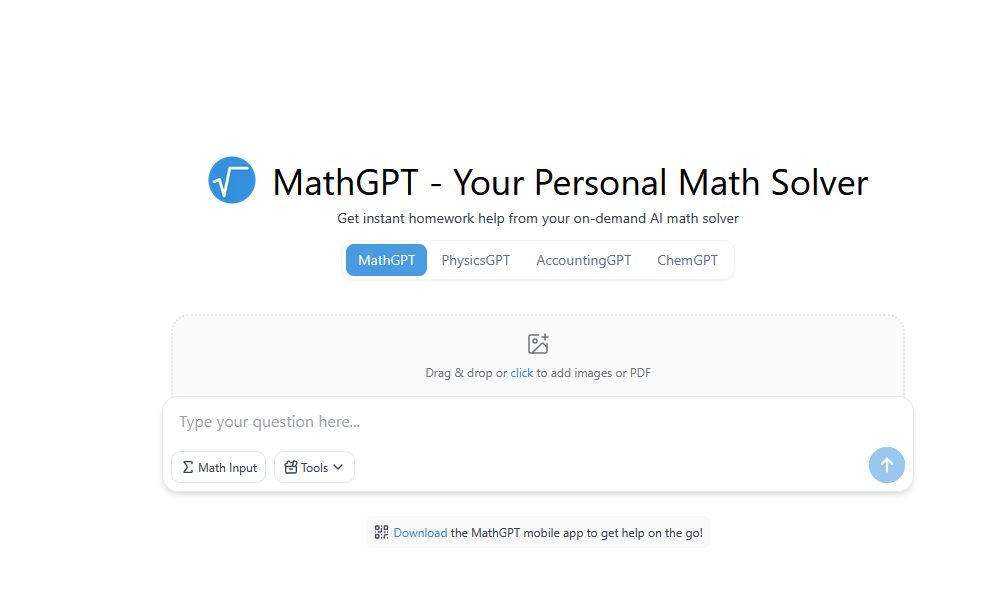
The interface supports multiple input styles—typed questions, image uploads, and PDFs—so it fits real classroom material (handwritten worksheets, textbook screenshots, and scanned assignments). For many users, the best workflow is: upload the problem, read the explanation, redo the steps on paper, and then ask targeted questions where your work diverges. Used that way, MathGPT behaves more like a tutor than a calculator.
MathGPT also highlights richer explanation modes such as video-style walkthroughs and visuals. Those can be useful for topics where seeing the process helps—graphs, geometry diagrams, calculus intuition, or multi-step algebra simplifications. For parents and tutors, it can generate a clean refresher explanation quickly and then you can decide how to teach it.
Access is commonly freemium: basic help is available for free, while higher limits, unlimited uploads, and premium explanation features are part of a paid “Unlimited” style plan (often with discounted annual pricing). That structure fits school reality, where usage spikes around tests and deadlines.
The key is to use the tool responsibly. Teachers can spot copy‑paste work quickly. If you treat MathGPT as a learning amplifier—check your steps, ask “why,” and practice the method—it can meaningfully improve confidence and accuracy.
Practical note: test with a small real job first to judge output consistency and whether it fits your workflow. Practical note: test with a small real job first to judge output consistency and whether it fits your workflow. Practical note: test with a small real job first to judge output consistency and whether it fits your workflow. Practical note: test with a small real job first to judge output consistency and whether it fits your workflow. Practical note: test with a small real job first to judge output consistency and whether it fits your workflow. Practical note: test with a small real job first to judge output consistency and whether it fits your workflow. Practical note: test with a small real job first to judge output consistency and whether it fits your workflow. Practical note: test with a small real job first to judge output consistency and whether it fits your workflow.